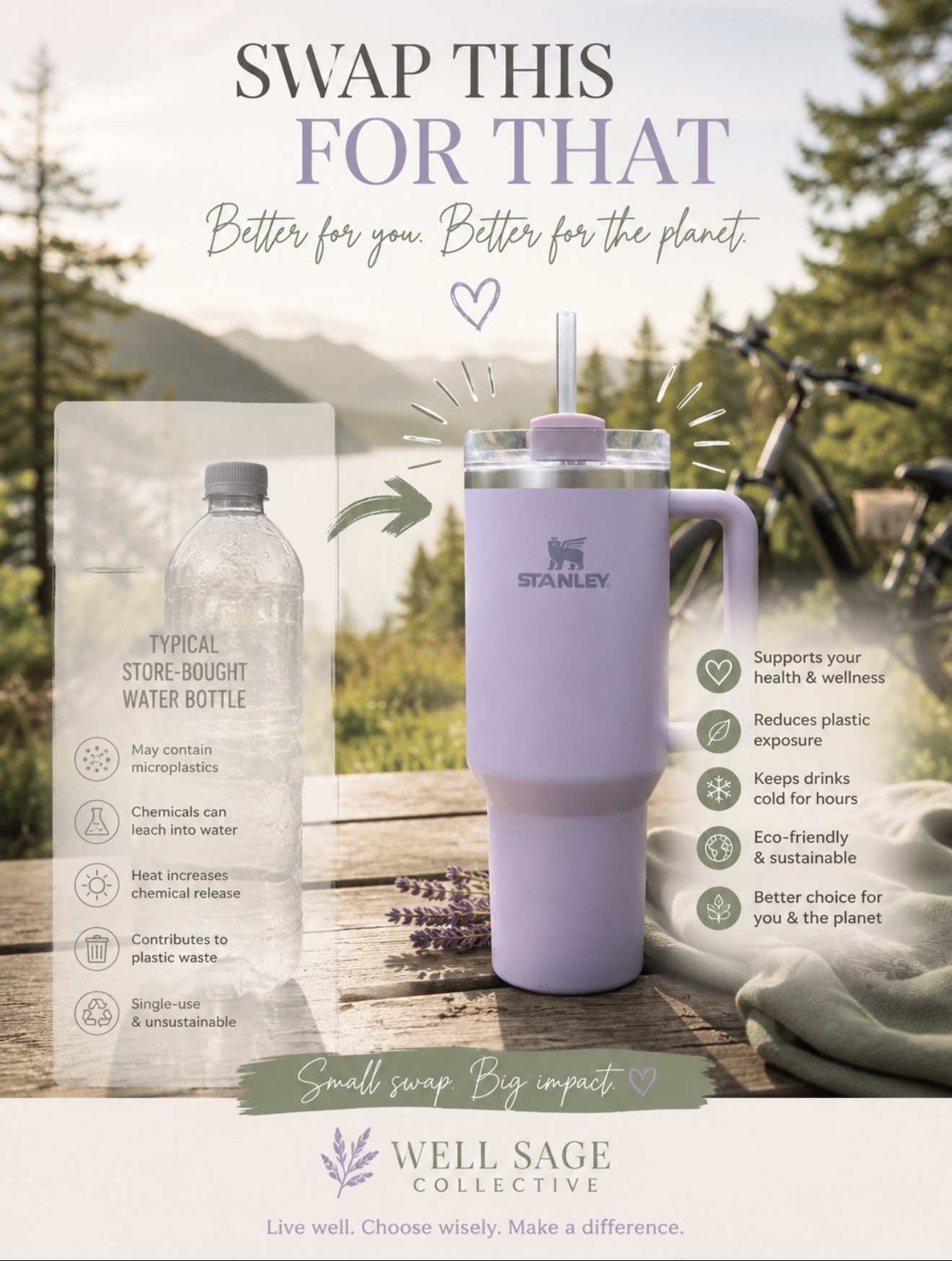

What’s Really In Your Water Bottle?
The truth about microplastics, chemical leaching, and why your hydration choice matters more than you think.
We spend so much energy choosing the right foods, the right supplements, the right skincare — and then we reach for a plastic water bottle without a second thought. But here’s what the research is telling us: the container matters just as much as what’s inside it.
Let’s talk about bottled water. It’s convenient, it’s everywhere, and most of us have grown up thinking it’s the cleaner, safer option. Countless brands have built billion-dollar markets on that assumption. But the science emerging over the last several years is asking us to take a much closer look, not at the water itself, but at what it’s being held in.
Microplastics are real, and they’re in your bottle
Microplastics are exactly what they sound like — microscopic fragments of plastic that break off from packaging, manufacturing processes, and the environment. Research has confirmed they’re showing up in our food, our air, and our water. Bottled water is a significant source.
These particles originate from several places: the bottle material itself breaking down, the cap, and the bottling and filtration process. A 2025 review published in the Journal of Hazardous Materials found microplastic concentrations in bottled water ranging widely, up to over 6,600 particles per liter across studies, with nanoplastics potentially present at even higher counts. Researchers identified plastic bottle necks, caps, and sunlight exposure as primary contamination contributors.
People who rely primarily on bottled water may ingest up to 90,000 additional microplastic particles each year compared to those drinking tap or filtered water. Let that number sit with you for a moment.
Why this concerns us from a health standpoint
Here’s where it gets important. Scientists are still building the full picture of long-term effects, and I want to be honest about that. But what the research already shows is concerning enough that it deserves attention now, not after the conclusions are neatly wrapped up decades from now.
Inflammation & oxidative stress
Ingested microplastics have been shown to trigger inflammatory responses and oxidative stress in the body, two drivers connected to nearly every chronic disease.
Cardiovascular concerns
A growing body of peer-reviewed research links microplastic exposure to vascular damage, reduced vessel flexibility, increased clotting risk, and disrupted lipid metabolism, all risk factors for heart disease.
Gut microbiome disruption
Research suggests ingested nanoplastics can disrupt the gut microbiota, the ecosystem in your digestive system that regulates immunity, mood, metabolism, and more.
Bioaccumulation in tissues
Microplastics have been found in human blood, placenta, arteries, and heart tissue. Once inside, they can cross biological barriers and accumulate over time.
A 2025 review in Annals of Medicine & Surgery found evidence linking microplastic exposure to reduced vessel flexibility, increased thrombosis severity, and disrupted lipid metabolism. Researchers have also detected these particles in human arterial plaques and blood clots. And a 2025 publication in Frontiers in Public Health summarized the mechanisms by which microplastics may contribute to cellular damage, inflammatory disease, and broader systemic harm across multiple organ systems.
The WHO has been monitoring this area since their 2019 report on microplastics in drinking water, and the conversation has only grown more urgent since. In late 2025, seven U.S. governors petitioned the EPA for nationwide microplastic monitoring in drinking water, a meaningful signal that regulatory attention is building.
Heat is the accelerant
Here’s something that doesn’t get talked about enough: temperature changes everything. When plastic is exposed to heat, sitting in a hot car, left in direct sunlight, stored in a warm pantry for months, the breakdown process accelerates. More plastic degrades. More particles leach into your water. This is not theoretical. It’s chemistry.
That case of water bottles sitting in your trunk through a summer road trip? The water inside has been exposed to sustained heat for hours or days. Even if the bottle “looks fine,” microplastic leaching increases significantly under those conditions. This applies to any brand of single-use plastic bottled water.
What about chemical leaching and BPA?
Most single-use water bottles today, including popular brands, are made from PET plastic (polyethylene terephthalate) and are marketed as BPA-free. This is worth knowing, BPA is an endocrine-disrupting chemical that was widely used in older plastics and has been linked to hormonal disruption. The industry largely moved away from it, which is a good thing.
However, and this is important, BPA-free does not mean chemical-free. Plastics can still migrate compounds into water, particularly under heat stress or with repeated use. A 2025 review of PET plastic bottles specifically found ongoing research concerns around chemical migration from recycled content and other additives. Choosing BPA-free is better than the alternative, but it doesn’t fully close the conversation.
Is any one brand of bottled water better than another?
To be straightforward with you: the water inside most commercial bottles is regulated, treated, and held to safety standards. The concerns are the same across the board, because they come down to the container, not the contents. Whether a brand filters, mineralizes, or sources from a spring, the plastic packaging is the common thread.
There is no compelling evidence that any one brand of bottled water is uniquely safer or more harmful than another when it comes to microplastic exposure. The issue is the plastic it lives in, and that issue belongs to the entire category.
Better options worth switching to
You don’t have to overhaul everything overnight. Even one intentional swap makes a difference, for your body and for the planet.
-
1
Stainless steel water bottle Durable, temperature-neutral, and completely plastic-free contact. This is the most practical everyday upgrade for most people, it goes everywhere your plastic bottle did.
-
2
Glass water bottle Ideal for home use or lower-activity settings. Zero chemical interaction with your water. Some come with protective silicone sleeves for travel.
-
3
Filtered tap water system If your local tap water quality is solid, a countertop or under-sink filter (or even a quality pitcher filter) can reduce contaminants while essentially eliminating plastic packaging from the equation. Storing filtered water in glass or stainless is the gold standard.
The Well Sage take
In the natural health community, we talk a lot about what we’re putting in our bodies. We read labels. We choose organic. We scrutinize ingredients. Water is no different, except the label we need to read is often on the outside of the bottle, not the inside.
The evidence-based conversation around bottled water in 2025 is not really about the water. It’s about cumulative, low-level exposure to materials our bodies weren’t designed to process, and about the reality that we have safer, equally accessible alternatives available to us.
Does this mean one plastic bottle ruins your health? No. Does it mean that making a thoughtful, consistent swap is a meaningful act of self-care? Absolutely, yes. That’s the kind of informed, empowered choice this community is built around.
Research & sources
-
NIH: Plastic Particles in Bottled Water Proceedings of the National Academy of Sciences, January 2024, the landmark study finding ~240,000 particles per liter of bottled water
-
Nano- and Microplastics in Single-Use Plastic Water Bottles: A Review MDPI, March 2026, synthesizes current research on occurrence, health risks, and regulatory gaps
-
Microplastics & Nanoplastics: Emerging Threats to Cardiovascular Health Annals of Medicine & Surgery, 2025, links plastic exposure to vascular damage, thrombosis risk, and lipid disruption
-
Microplastics as Emerging Cardiovascular Risk Factors: A Narrative Review PMC / Cureus, 2025, documents MNPs found in human arterial plaques and blood clots
-
Microplastics and Human Health: Toxicological Pathways and Public Health Implications Frontiers in Public Health, 2025, comprehensive review of inflammatory, oxidative, and systemic mechanisms
-
WHO: Microplastics in Drinking Water World Health Organization, 2019, foundational global assessment and call for further research
-
Food & Water Watch: The Mega-Crisis of Microplastics in Our Drinking Water Includes 2025 update on governors’ EPA petition for nationwide microplastic monitoring
You deserve to know what’s in your water. And you deserve options that protect both your health and the world you live in. Small swaps, made consistently, are how we build a life that feels as good as it looks.
— Well Sage Collective


Leave a Reply